Property Management Games by Scale: House to City
The 30-second answer
I ran this search on 20 August 2026 and page one had almost no games on it. Two of the results were posts written by companies that sell rental software, zeevou.com and occupancysolutions.com, and the rest of the page was a browser clicker on CrazyGames and a couple of phone idle titles from the app stores. The zeevou post is a real games roundup, headlined as six picks, but four of those six are phone games and only two are on Steam. The list a player would write is below, sorted the way the question actually splits: by how much property you are willing to be responsible for.
The best single answer is The Tenants, because it puts the actual job at the center of the screen: screen the applicants, set the rent, repair what they break, repeat. Take Project Highrise instead if you would rather run the building than the people inside it, and Minami Lane if one evening and $4.99 (as of August 2026) is the whole budget.
Updated August 2026.
What counts as a property management game
A property management game is a simulation whose subject is the property itself at whatever scale you pick, from one house to a whole city, and the money it makes pays for the next thing you do to it.
Three jobs decide whether a game is really doing that, and they are the test I use for the rest of this page: you pick the occupant, you set the rent, you answer the complaint. Not every game below clears all three, and where one does not I say which parts it misses.
That definition covers four different kinds of game that have almost nothing in common at the controls. A house-flipping sim and a city builder are both about property and they ask completely different things of you every minute you play. Scale is what separates them, because scale decides what your recurring decision is and what a bad decision costs.
| Scale | The decision you keep making | How you lose money |
|---|---|---|
| One property | Which rooms to gut, and what the fit-out is worth | The renovation costs more than the sale returns |
| One building | Who moves in next to whom, and what the building owes them | Empty units, plus tenants who leave over something small |
| One street | Which shops open, what they charge, how the street looks | People stop walking down it |
| One city | Where to zone, what to tax, which services to fund | Services outrun the tax base, and traffic finishes the job |
One note on that first row, because it is a deliberate substitution. A single rented apartment barely exists as a game on its own, so the smallest scale here is a property you own and work on, and renting only starts on the second row.
The narrower term for that second row is apartment management game, and it is where most of the good ones live. The third, one street, is nearly empty.
The eight, at a glance
| Game | Scale | Regular price (as of August 2026) | Steam reviews (as of August 2026) |
|---|---|---|---|
| House Flipper | One property, then sell it | $24.99 | 111,340 at 94.0% positive |
| Landlord’s Super | One property, brick by brick | $19.99 | 1,707 at 80.6% positive |
| The Tenants | One building, many units | $19.99 | 7,761 at 78.9% positive |
| Project Highrise | One tower, offices and apartments | $19.99 | 4,811 at 84.9% positive |
| Minami Lane | One street | $4.99 | 6,667 at 97.4% positive |
| Block’hood | One neighborhood, stacked in blocks | Not in this pass | Not in this pass |
| Cities: Skylines | One city | $29.99 | 291,458 at 92.9% positive |
| Big Ambitions | A portfolio, bought across one city | Not in this pass | Not in this pass |
Prices are the regular list price, so anything running a discount when you look will read lower. Two rows carry no figures at all: Block’hood and Big Ambitions were not in the August sweep, so I quote no price and no score for either one anywhere on this page.
One property: you own it, you fix it, you leave
House Flipper
House Flipper is the pick when the appealing part of property is the before-and-after. Its store page sets out the loop in one line: “Buy, repair and remodel devastated houses. Give them a second life and sell them at a profit.” You clean, strip, paint, tile, install and furnish, then the house leaves your hands. There is no rent, no lease, and no resident with an opinion, so it clears none of the three jobs. It runs on Windows and macOS.
Set Cities: Skylines aside and House Flipper has more reviews than the other four review counts in the table above put together, five times over. Restoration is popular. Landlording is niche.
The 2018 original is still the one I would point at for this question, ahead of House Flipper 2. The sequel is the better-looking game and it is Windows only, at $39.99 with 19,797 reviews at 87.2% positive (as of August 2026), where the original costs fifteen dollars less and still runs on a Mac. Neither version has a tenant in it. If it is the restoration half you are after, games like House Flipper covers the rest of that shelf.
Landlord’s Super
You mix the cement yourself. You order the bricks, stack the scaffolding, lay the walls by hand and wait for the weather to let you carry on. Landlord’s Super is worth $19.99 (as of August 2026) for that job and for very little else, because the management screen barely exists. The Steam description is clear about the shape of it: “Take a dodgy loan, restore a property, move in the locals, attend to their grievances, then celebrate with a pint in this fully-simulated, open-world 1980’s Britain.”
Tenants do arrive and they do complain, so two of the three jobs are technically present, but the grievance system is thin next to the construction, and at 80.6% positive across 1,707 reviews the split in the reviews is mostly about that: people who wanted a building sim and got a first-person job. It is Windows only.
One building: the rung that actually matches the search
Two games sit on this rung, and what separates them is who signs the lease: a person or a company. Hotel sims keep turning up in this search and none of them are here, because a guest checks out in the morning and takes the whole relationship with them: no lease, no rent roll, nobody to screen. The roundup of apartment building management games stays at this scale from end to end if it is the only one you care about.
The Tenants
The Tenants is the closest thing on Steam to the job the phrase describes, and it is also the most divisive game here. The store page puts the pitch as “Become a landlord and deal with problematic tenants as you build your rental property empire”, and the loop is exactly that: buy a unit, renovate it, pick who moves in from a list of applicants, then handle what happens next. The same page asks whether you will “design your apartment for a group of gamer friends or an aspiring musician looking for a new home”, which is the part no other game on this list attempts. A tenant has preferences, and matching the fit-out to the person is how the rent goes up.
At 78.9% positive across 7,761 reviews (as of August 2026), it is the lowest of the six scores in the table above. The complaints cluster around repetition: the renovation minigames stay the same after twenty units, and the tenant events start recycling. The matching problem is what you are paying for; the long tail thins out. Windows only, which rules it out on a Mac.
Project Highrise
Your tenants here are businesses more often than people. Offices, restaurants, retail and residential apartments all want different things, and the building has to deliver power, water and enough elevator throughput to stop everyone hating you at nine in the morning. The store page is blunt about the responsibility: “As the building owner you must keep your tenants happy - and paying rent on time.” It is the best-built game in this list, and the furthest from the day-to-day of a landlord.
It holds 84.9% positive across 4,811 reviews (as of August 2026), the stronger of the two scores on this rung, and it runs on Windows and macOS. It sits in the same tradition as the tower sims of the nineties, which the history of management sim games traces if you want the lineage.
One street: where the genre nearly vanishes
Between one building and one city there should be a whole tier of games about a block, a lane, a terrace of houses. There is almost nothing. One game does the scale well, one older game does it strangely, and nothing released has come along since.
Minami Lane
You set the price of a bowl of ramen, place the houses and the decorations, then read what the street says about it the next morning. Minami Lane is the best value on this page by a wide margin, and it is over in an evening. Its store page describes “a tiny cozy, casual management sim” where you build a street, run its shops and maximize villager happiness, and the same page promises “2 to 4 hours of playtime” before you buy.
At 97.4% positive across 6,667 reviews (as of August 2026) it is the highest-scoring game listed above, and at $4.99 the risk is close to zero. It is also the loosest fit for the phrase at the top of this page: you set prices and you answer complaints, but there is no lease, no rent roll, and no tenant you can refuse. Buy it for what it is, a short and complete game. If you want more of that specific street feeling, games like Minami Lane is the follow-up.
Block’hood
Block’hood is the odd one out and the reason the street tier is not empty. Its Steam page calls it “a neighborhood-building simulator” with over two hundred blocks that you stack into a neighborhood, and every block consumes something another block produces. Starve a block of its input and it decays and is abandoned.
It is closer to an ecology puzzle than to a rent business, and it has aged far enough that I list it as a curiosity. It sits in the table above with no numbers next to it, because it was not one of the games I checked in August 2026. It does run on Windows, macOS and Linux. I mention it because it is the only other game I found that treats a neighborhood as the unit of management, and because nothing has replaced it.
One city: zone it, or buy into it
Two games reach city scale from opposite seats. The ladder row further up describes the first one: you draw the map, set the tax rate, and never hold a deed on any of it. The second inverts that, and the deeds are the only thing you hold.
Cities: Skylines
Zoning is as close as you get to placing a building. You mark land residential, commercial or industrial, and buildings grow on it according to demand, taxes and how well you have served the area. Cities: Skylines is the right answer only if what you actually wanted was to shape where property goes, and it will frustrate anyone who came for tenants. The store page describes juggling “education, water electricity, police, fire fighting, healthcare and much more” alongside a traffic simulation that will eat your city whole if you lay the roads badly.
At 291,458 reviews and 92.9% positive (as of August 2026) it is the most established game here by an enormous distance, and it runs on Windows, macOS and Linux. Cities: Skylines II is out, and the 2015 original is still the one I point at for this question: the sequel is Windows only and its reviews sit a long way below the original’s, which was not in the August sweep, so I quote no figures for it. Both of them fail all three parts of the test near the top of this page, which puts Skylines at the edge of this category. The individual resident exists but you never meet them. Your relationship is with the grid.
Big Ambitions
Big Ambitions is the only game here that hands you a portfolio instead of a property. You start on the wrong side of the lease, and its store page lists that opening in order: “Take out a loan, rent a building, design the logo, renovate the store, get stock, manage your money, hire staff”. Later the seat flips, because the same page says “Enter any building in New York and buy it” and “Invest your hard-earned cash in real estate to grow your empire”. The unit of management is a set of addresses scattered across a map, which nothing else on this page attempts.
Measured against the three jobs it clears none of them, and the reason is worth knowing before you buy. The occupant of a building you own is usually your own shop, so there is nobody to screen, no rent to set for a stranger and no complaint arriving from a tenant. What you get instead is the acquisition half of property, the part where you look at a street and work out what you could afford on it. Its table row is empty for the same reason Block’hood’s is, and it runs on Windows and macOS.
One from us, sitting beside the list
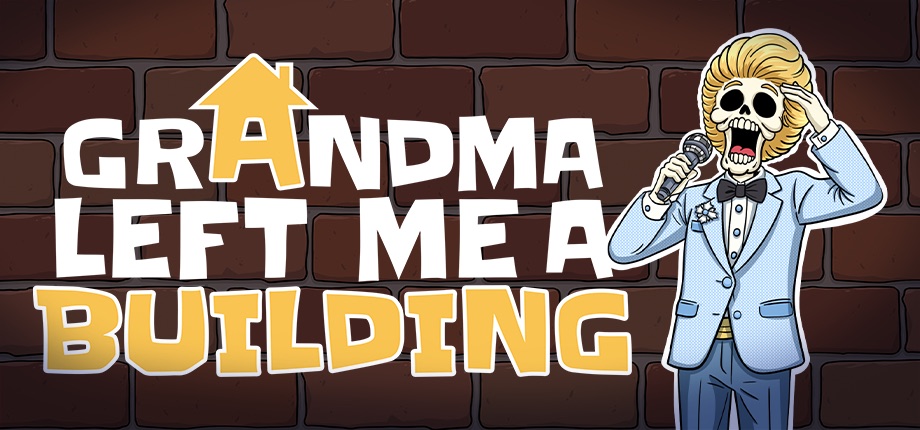
Our own debut, Grandma Left Me a Building, sits next to this list rather than on it, at the one-building rung. You inherit a run-down building from your grandmother, find tenants, collect rent, upgrade the place and hire staff, with drag-and-drop tenant placement and income that moves with how happy the residents are. The tenant pool changes with your building’s reputation, so who is willing to move in becomes a consequence of how you have run the place. The neighbours include a midnight guitar-shredding elf and a philosophy-lecturing yeti, and keeping mismatched ones from clashing is the job.
What I cannot tell you is whether that loop holds up over a long game. It is unreleased, due 10 November 2026 on Steam for Windows and macOS, so there are no scores or sales to point at yet.
Quick answers
Is there a property management game where I actually collect rent? Yes, three of them. The Tenants, Project Highrise and Landlord’s Super all run on money from occupants you accepted, though in Project Highrise most of those occupants are companies taking an office lease. Big Ambitions puts you on the paying side of that lease for its opening hours. House Flipper and Cities: Skylines never see one: the first sells the property, the second taxes it.
What is the cheapest game on this list? $4.99, Minami Lane. Nothing else that carries a price is under $19.99 (as of August 2026), and three of them sit exactly on that number, so there is a fifteen-dollar hole at the bottom of this list. Minami Lane is also one of only three games in the table that run on Windows, macOS and Linux, if that is the thing that decides it for you.
Which of these run on macOS? Six of the eight. The two exceptions are Landlord’s Super and The Tenants, and The Tenants is the game this page recommends first, so the list breaks in an annoying place if you are on a Mac. Minami Lane, Block’hood and Cities: Skylines are the three that add Linux on top.
Are there any games about managing a whole street? Two. Minami Lane is the only current game that does the street scale well, and Block’hood is the only other one that tries. The nearest thing to a third is Neighborhoods, which has no release date on its Steam page and describes itself as “a cozy city sim where you shape streets to help people thrive, gather, and develop strong opinions about a particular bench”.
Every price, score and review count on this page came from the Steam store on 20 August 2026. All of them drift. Regular prices are quoted throughout, and platform support does get added after launch, so glance at the store icons before you buy.